Korea has two stock markets, KOSPI and KOSDAQ. Here's what actually separates them — with live, English data instead of hand-waving.
If you've started looking at Korean stocks, you've run into two names: KOSPI and KOSDAQ. Most English explanations stop at "KOSDAQ is Korea's NASDAQ" — which is half right and badly misleading. The tech tilt is real. The size comparison is not.
This is a plain-English guide to the difference, why it matters for how you read "Korean stocks," and how to slice the two boards yourself on a free screener.
The difference in one glance
Sort each board by market cap and the gap is immediate. On KOSPI, the top of the list is a wall of familiar global names:
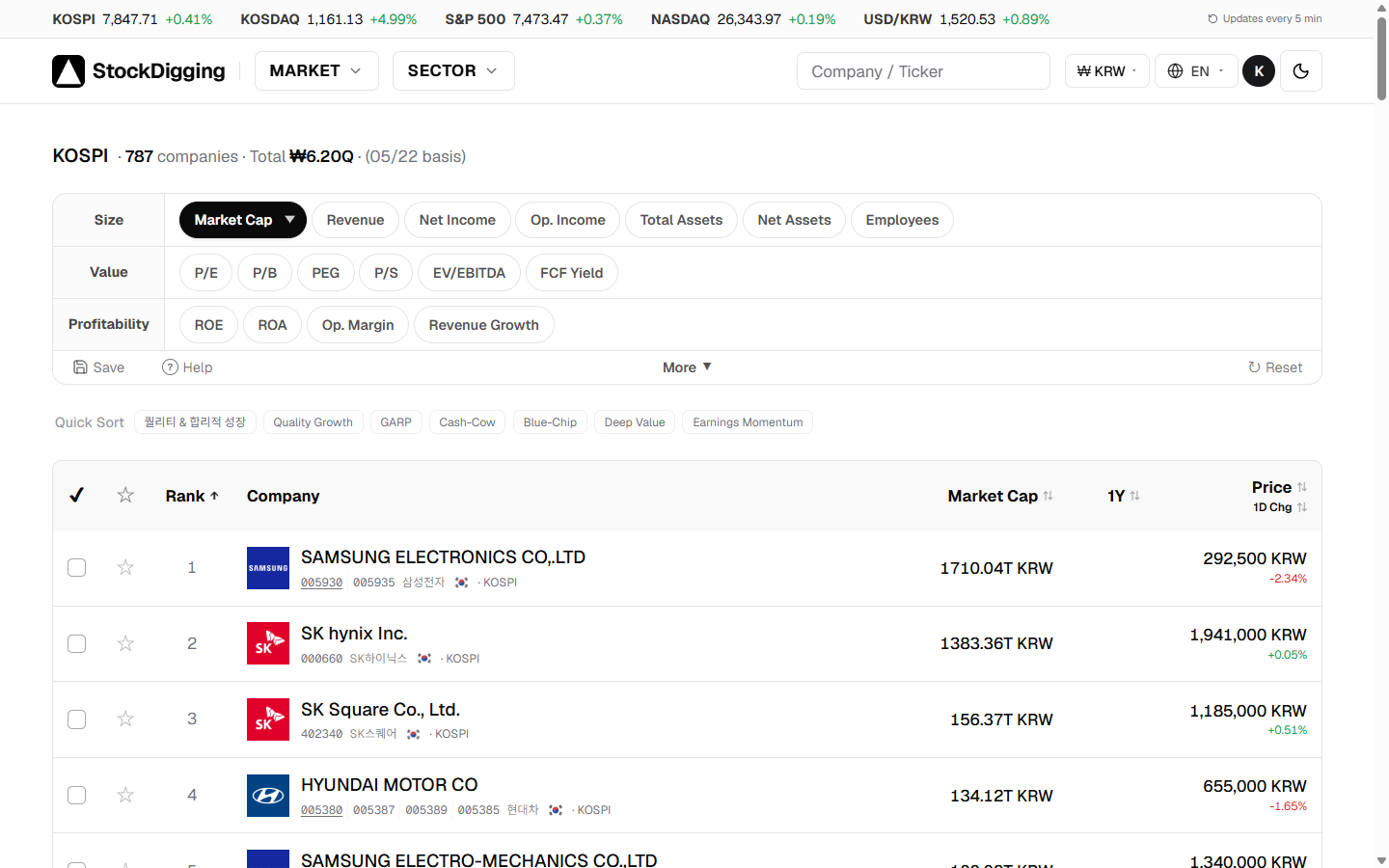
- Samsung Electronics — ₩1,710T (~$1.12T)
- SK hynix — ₩1,383T (~$910B)
- SK Square — ₩156T (~$103B)
- Hyundai Motor — ₩134T (~$88B)
- Samsung Electro-Mechanics — ₩100T (~$66B)
Now the same ranking, filtered to KOSDAQ:
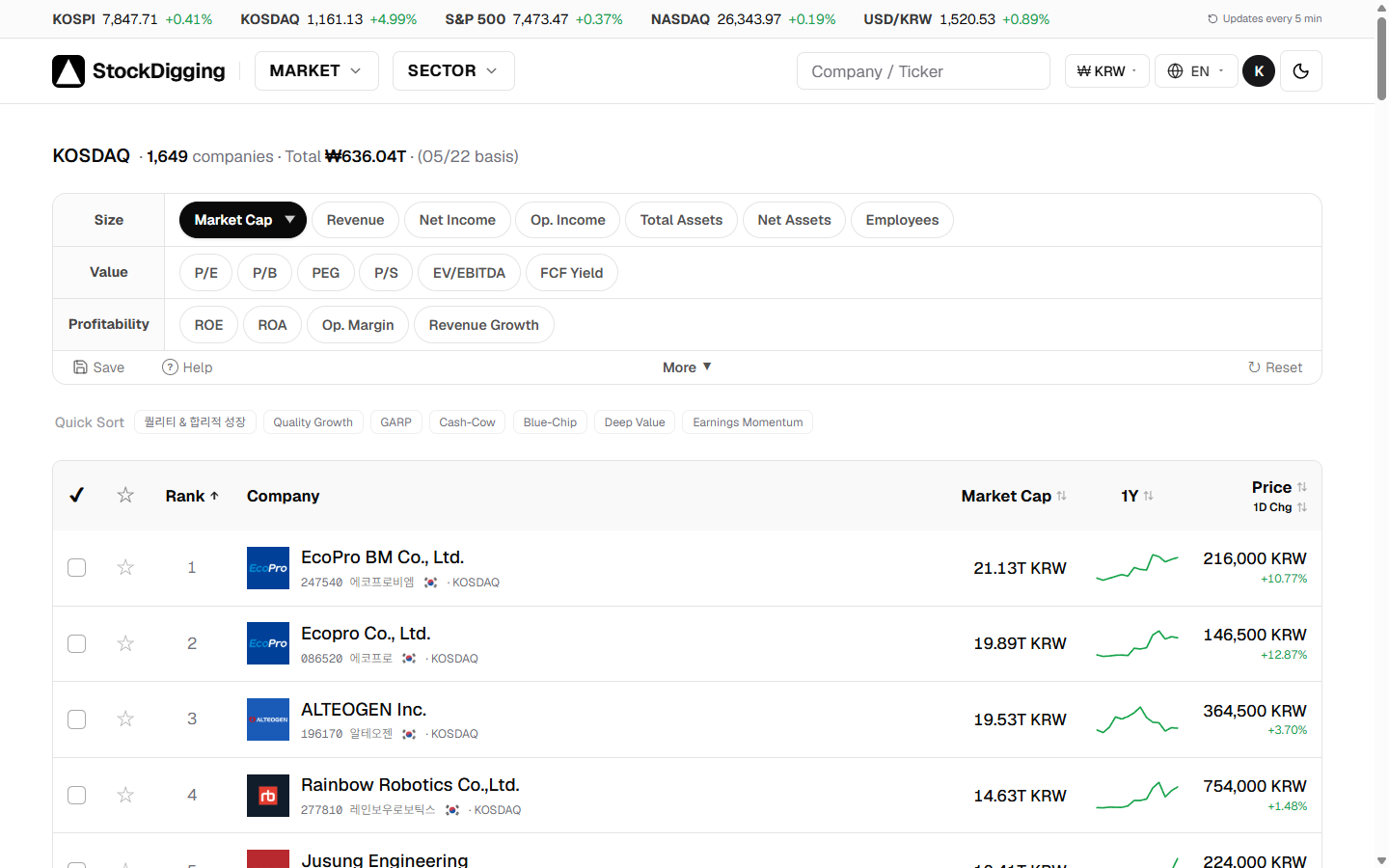
- EcoPro BM — ₩21T (~$14B) — EV battery cathode materials
- Ecopro — ₩20T (~$13B) — battery-materials holding company
- Alteogen — ₩20T (~$13B) — biotech (drug-delivery platform)
- Rainbow Robotics — ₩15T (~$10B) — robotics
- Jusung Engineering — ₩10T (~$7B) — semiconductor equipment
Here's the part the "Korea's NASDAQ" line hides: the single largest KOSDAQ company is smaller than the sixth-largest name on KOSPI. Samsung Electronics alone is worth roughly 80× the entire market cap of KOSDAQ's biggest stock.
What KOSPI is
KOSPI(Korea Composite Stock Price Index) is the main board — the home of Korea's largest, most established companies. Semiconductors (Samsung, SK hynix), autos (Hyundai), components, steel, finance, and the big battery makers all list here. When a global investor says "Korean stocks," they almost always mean KOSPI by default.
It's also where the AI-memory story lives: Samsung and SK hynix supply the high-bandwidth memory (HBM) that goes into NVIDIA's data-center GPUs, which is much of why Korea has been back in global market-cap conversations.
What KOSDAQ is
KOSDAQ is the growth-oriented secondary board — younger, smaller, more volatile, and more retail-driven. Its character is visible right in the leaderboard above: EV battery materials (Ecopro group), biotech (Alteogen, Kolon TissueGene), robotics (Rainbow Robotics), and semiconductor equipment(Jusung). It's where Korean investors go hunting for earlier-stage, higher-growth themes.
The size reality
The counterintuitive part: KOSDAQ lists far more companies than KOSPI. On StockDigging, that's roughly 1,650 KOSDAQ names vs about 790 on KOSPI. But add up their market caps and the picture flips hard:
- KOSPI total — about ₩6,200T (~$4.1T)
- KOSDAQ total — about ₩640T (~$420B)
KOSDAQ has roughly twice the number of listings but only about one-tenthof KOSPI's combined market cap. Many small companies, not much aggregate weight. That is the opposite of the US picture, and the single most important thing to internalize about the two boards.
How to slice the two boards yourself
Everything above came from one screener with an exchange filter. On the Korea rankings page, KOSPI and KOSDAQ are simple checkboxes — tick either one (or both) and the table re-ranks in place. The sort metric and range filters stay applied, so you can ask things like "KOSDAQ only, highest ROE" or "KOSPI only, lowest P/E."
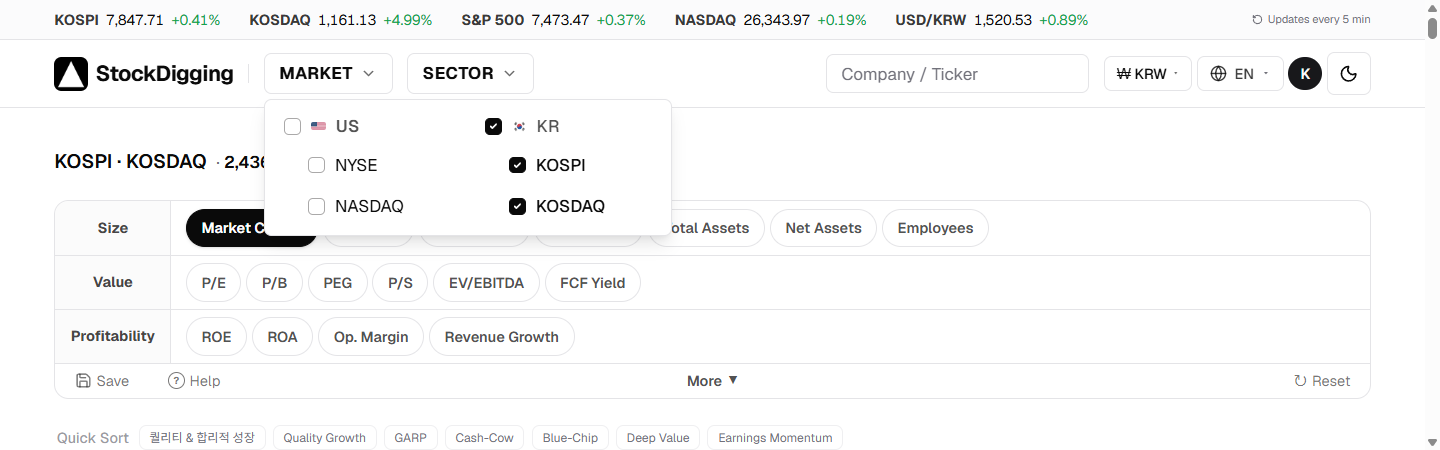
Live, daily-updated: Korea market cap rankings (KOSPI & KOSDAQ). Rankings refresh after the Korean market close; market cap is the day's closing price × shares outstanding.
KOSPI giant vs KOSDAQ leader, side by side
To make it concrete, here are the #1 names on each board side by side in the compare view — Samsung Electronics (KOSPI) vs EcoPro BM (KOSDAQ), same currency, same metrics:
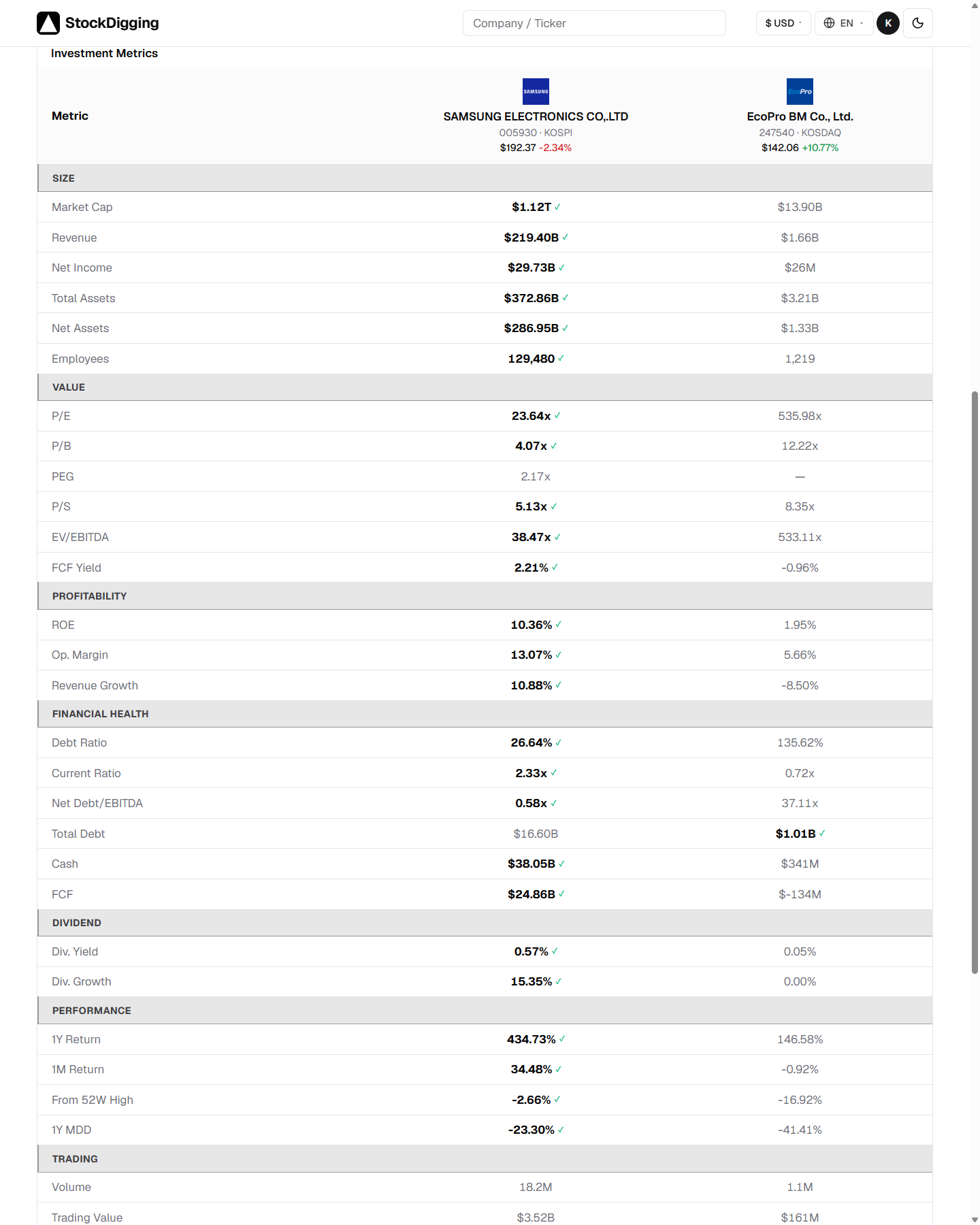
Two things jump out. The size gap — market cap $1.12T vs $13.9B, roughly 80×. And a valuation inversion: Samsung trades around 24× earnings, while EcoPro BM sits near 540×. That's the two boards in a single table — an established large-cap priced on what it earns today, versus a thematic growth name priced on what comes next. Neither is "better"; they're different jobs in a portfolio. Open this comparison.
Bottom line
- KOSPI= the main board, the giants, what "Korean stocks" usually means.
- KOSDAQ = the growth board: more listings, far smaller companies, tilted to battery materials, biotech, robotics, and chip equipment.
- The tech-tilt parallel to NASDAQ is fair; the size parallel is not. KOSDAQ is about one-tenth of KOSPI by total market cap.
- To work with both, start from the Korea rankings, toggle the exchange filter, then sort by whatever metric fits your thesis.
For a deeper look at the names at the very top, see How to Track the Largest Korean Companies by Market Cap. Nothing here is investment advice — all figures are point-in-time snapshots, and the linked pages carry the live numbers.
Open Korea Market Cap Rankings →
StockDigging is a free, English-friendly screener for Korean and US stocks — KOSPI, KOSDAQ, NYSE, NASDAQ in one place, no signup, updated daily. Korean data comes from DART, Korea's official filing system.